



Choosing a platform for an online store in 2026 has become much more complicated than it was a few years ago. Businesses no longer need “just a website.” They need a store that can handle advertising traffic, survive updates without breaking, integrate properly with CRM systems, load fast on mobile devices, and scale without turning into a constant technical headache.
Business owners increasingly compare three main options: WordPress + WooCommerce, OpenCart, and Laravel.
And while Laravel used to be associated with “expensive and slow custom development,” the situation has changed significantly. Modern custom development no longer means building everything from scratch. Many agencies, including NextDoorCoders, already have ready-made Laravel modules, architectural solutions, and reusable systems that allow high-quality eCommerce websites to launch faster than overloaded CMS projects filled with unstable plugins.
In this article, we’ll break down:
- the strengths of each platform;
- where CMS solutions work best;
- when Laravel becomes a smarter long-term investment;
- what actually costs less over time;
- and how to choose the right platform for your business in 2026.
WordPress + WooCommerce: Fast Launch for Small Businesses

WooCommerce remains one of the most popular ways to launch an online store. The reason is simple: low entry cost. Businesses can get a working website relatively quickly and without huge upfront investments.
For smaller stores, WooCommerce is often a very practical solution:
- catalogs with a few thousand products;
- standard checkout functionality;
- basic SEO tasks;
- simple payment and delivery integrations;
- minimal custom business logic.
WordPress works especially well for companies that want to test a niche quickly or launch an MVP without investing heavily in custom development.
However, there’s an issue that many businesses only discover later.
Over time, most WooCommerce stores become overloaded with plugins:
- SEO tools;
- caching systems;
- filters;
- multilingual functionality;
- CRM integrations;
- marketplace integrations;
- warehouse management tools;
- automation plugins;
- custom checkout solutions.
After a year or two, the project often turns into a system where every update risks breaking something.
WordPress is excellent for a fast launch. Long-term scalability is a different story.
OpenCart: A Balance Between Speed and eCommerce Functionality

OpenCart has remained popular among eCommerce businesses for years — and for good reason.
Unlike WordPress, which originally started as a content management system, OpenCart was built specifically for online stores. It already includes:
- product management;
- categories;
- options and attributes;
- filtering systems;
- order management;
- multilingual support;
- eCommerce-focused structure.
Because of this, OpenCart often performs faster out of the box than WooCommerce.
For small and medium-sized businesses, it can be a very balanced solution:
- faster launch process;
- more logical store architecture;
- less dependency on huge numbers of plugins;
- simpler administration.
Still, OpenCart also has limitations.
As businesses grow, they usually require features that become difficult to implement within a template-based CMS architecture:
- advanced B2B functionality;
- personalized pricing;
- complex order workflows;
- multi-warehouse systems;
- ERP integrations;
- business process automation;
- advanced SEO management;
- custom checkout logic.
At this stage, OpenCart projects often begin accumulating technical debt:
- module conflicts;
- difficult updates after customization;
- declining performance;
- overloaded databases;
- duplicate pages and SEO issues.
OpenCart remains a solid middle-ground option between launch speed and eCommerce functionality — up to a certain business scale.
Laravel: When a Business Needs More Than Just a CMS
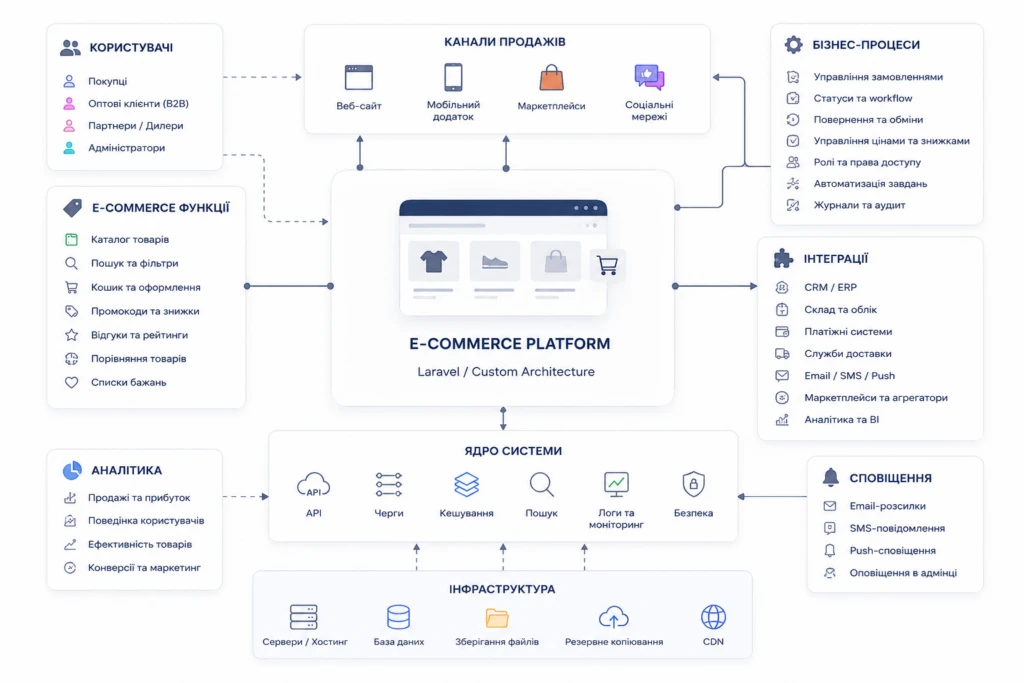
Laravel is no longer simply a “website framework.” It’s a full-scale foundation for building custom eCommerce systems.
What matters here isn’t launch speed — it’s control.
With Laravel, businesses can build systems around their processes instead of adapting their business model to CMS limitations.
This becomes especially important for:
- B2B platforms;
- manufacturers;
- wholesale businesses;
- marketplaces;
- custom business logic;
- complex integrations;
- large product catalogs;
- high-traffic stores.
A few years ago, Laravel’s biggest downside was development time. Today, that’s no longer always true.
At NextDoorCoders, we already have ready-made Laravel modules and architectural solutions for:
- authentication systems;
- eCommerce components;
- integrations;
- SEO structures;
- admin panels;
- caching systems;
- queues;
- API architecture.
Because of this, many core systems no longer need to be built from scratch.
In real-world projects, this often creates an unexpected result: a custom Laravel store can launch faster than an overloaded OpenCart or WordPress website filled with unstable plugins, module conflicts, and update issues.
This becomes especially noticeable in projects that require:
- stability;
- scalability;
- performance;
- advanced integrations;
- custom workflows;
- long-term flexibility.
What Actually Costs Less: CMS or Laravel?
Most businesses ask the wrong question.
They focus only on the initial launch budget. But the more important question is: how much will this platform cost over the next 3–5 years?
At the beginning, WordPress and OpenCart are usually cheaper.
But later, hidden costs start appearing:
- paid plugins;
- update conflicts;
- constant fixes;
- performance issues;
- technical debt;
- unstable integrations;
- difficult maintenance;
- SEO problems;
- plugin overload.
Laravel is usually more expensive at launch, but often cheaper when scaling.
The reason is simple: the architecture is designed correctly from the start.
Without chaotic plugin systems.
Without dozens of third-party dependencies.
Without adapting business processes to CMS limitations.
And the larger the business becomes, the more noticeable this difference gets.
SEO: Where Most Problems Begin
Many business owners think SEO depends only on content. In reality, the platform itself heavily affects search performance.
In WordPress, the biggest issue is plugin overload. One plugin generates sitemaps, another changes canonicals, and a third accidentally creates duplicate pages.
In OpenCart, a common issue is filter-based SEO duplication. Poorly configured filtering systems can generate thousands of technical URLs indexed by Google.
Laravel is more difficult at the beginning, but it provides one major advantage: complete SEO architecture control.
You can properly implement:
- URL structures;
- canonicals;
- pagination;
- filtering logic;
- caching;
- sitemaps;
- schema markup;
- multilingual SEO;
- indexing control.
Without fighting against CMS limitations.
So Which Platform Should You Choose in 2026?
There’s no universal answer.
If your business needs:
- a fast launch;
- a lower starting budget;
- an MVP;
- a relatively simple online store — then WordPress or OpenCart can be excellent solutions.
But if your company plans:
- scaling;
- automation;
- B2B functionality;
- advanced integrations;
- high traffic;
- custom business processes — then Laravel often becomes the more stable long-term investment.
The most important thing is not choosing a platform only for today.
You should choose based on what your business is expected to become in the next several years.
That’s where the real difference between CMS platforms and custom Laravel architecture becomes truly visible.