



Launching an online store is not just about “building a website.” For a business, it’s an investment in sales, automation, and future growth. One of the most expensive mistakes is choosing a contractor based only on attractive design or the lowest price.
Most problems have nothing to do with the CMS or technology itself — the real cause is usually weak planning, poor architecture, or chaotic development without clear processes.
In this article, we’ll explain how to choose the right eCommerce development agency and which questions you should ask before signing a contract.

Why Choosing the Wrong Agency Can Be Expensive
Mistakes in selecting a contractor are rarely visible at the beginning. At first, everything looks fine: there are mockups, the website works, products are uploaded.
But after a few months, the real problems begin:
- the website becomes slow;
- SEO performance does not improve;
- making changes becomes difficult;
- checkout breaks after updates;
- integrations work unstably;
- every modification becomes expensive;
- there is no proper technical support.
Businesses end up either constantly “patching” the store or rebuilding it completely within a year or two.
Question #1. What Technologies Do You Specialize In?
A good agency does not do “everything for everyone.”
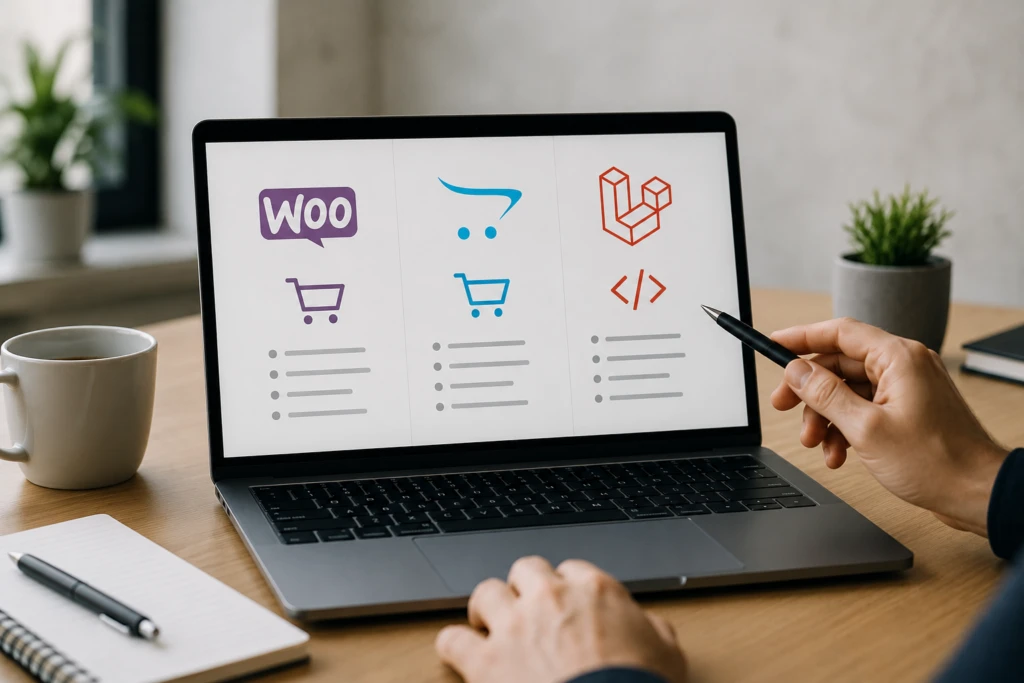
Some teams specialize in WooCommerce, others in OpenCart, and some focus on Laravel or custom B2B systems.
You need to understand:
- what type of projects they build most often;
- what industries they work with;
- whether they have experience in your niche;
- whether they have launched stores with similar requirements.
For example, a fashion store and a B2B platform for a manufacturer require completely different architecture.
If your business needs:
- personalized pricing;
- user roles;
- complex integrations;
- business process automation,
then an agency focused only on template-based websites may not be the best choice.
Question #2. Which CMS or Technology Do You Recommend and Why?
If an agency immediately pushes “only WordPress” or “only Laravel” without analyzing your business needs, that’s a warning sign.
A professional team first asks about:
- number of products;
- expected traffic;
- SEO requirements;
- integrations;
- scaling plans;
- B2B functionality;
- marketing goals;
- budget and timeline.
Only after that should they recommend a platform.
Question #3. What Is Included in the Price?
One of the most common problems is a “cheap” estimate that later becomes two or three times more expensive.
Always clarify whether the price includes:
- responsive design;
- basic SEO optimization;
- website speed optimization;
- cache configuration;
- payment and shipping integrations;
- product import;
- multilingual setup;
- testing;
- post-launch support.
You should also ask:
- which plugins are paid;
- whether licenses are required;
- who pays for hosting;
- how much future improvements will cost.
Question #4. How Is Your Workflow Organized?
A strong agency always has a clear process.
Usually, it looks like this:
- Business analysis and requirements gathering
- Prototyping
- Design
- Development
- Testing
- Content upload
- Launch
- Support
If someone says, “Send us examples and everything will be ready in a month,” that’s risky.
Make sure to ask:
- whether there is a project manager;
- how tasks are managed;
- where communication happens;
- how deadlines are controlled;
- whether they use a staging server for testing.
Question #5. How Do You Handle SEO?
Many online stores are built without considering SEO structure from the start.
This typically shows up as:
- duplicate pages;
- filter indexing problems;
- poor crawling;
- slow loading speed;
- weak internal linking.
Ask the agency:
- how they build URL structures;
- how SEO filters are implemented;
- whether they optimize Core Web Vitals;
- how internal linking is organized;
- whether schema markup is included;
- how duplicate pages are handled.
For eCommerce projects, this is critical.
Question #6. What Happens After Launch?
Many business owners think the store is “finished” after launch.
The bulk of the work usually starts once the store is live:
- bug fixing;
- conversion optimization;
- scaling;
- updates;
- security;
- integrations;
- performance optimization.
So ask about this upfront:
- whether support is available;
- SLA conditions;
- backup systems;
- monitoring;
- disaster recovery;
- regular updates.

Question #7. Can You Show Real Case Studies?
Ask to see:
- live stores;
- admin panels;
- website speed;
- SEO structure;
- integration examples.
Do not focus only on design.
A good online store is:
- stable;
- fast;
- easy to use;
- logically structured;
- mobile-friendly;
- simple to manage.
Signs of a Good Agency
Here are several positive signals:
- they ask many questions about your business;
- they do not promise “everything in two weeks”;
- they explain technical decisions in simple language;
- they openly discuss risks;
- they think about scalability;
- they have clear processes and documentation;
- they show real case studies;
- they do not try to sell unnecessary features.
Red Flags You Should Never Ignore
Be careful if the agency:
- cannot explain the architecture;
- ignores SEO;
- offers no support;
- works without contracts;
- gives rough estimates without analysis;
- promises “any functionality without problems”;
- asks nothing about your business.
This often leads to overspending and complete rebuilds later.
Conclusion
The right agency is not just a contractor — it’s a long-term technical partner for your business.
Price and design are the parts you notice right away. Architecture, support, and whether the team can actually help you scale — that shows up later, often a year or two after launch. A couple of hours spent on these questions before you sign is cheap compared to what a rebuild costs.
It’s cheaper to ask now than to rebuild later.