


What Happens to a Lead Between the Click and the Manager’s Response
When a customer fills out a web form, the lead first lands in an inbox, and only afterwards does someone on the team manually move it into a spreadsheet or file used by the people working with customers. This manual transfer takes time. If the manager is busy, some leads become lost before the first call ever happens. The situation gets worse when the website has a callback button, since leads from it are often processed separately. The most common reasons leads get lost:- it gets buried among the site administrator’s other emails;
- the manager receives the contact details with a delay of several hours;
- duplicate contacts appear because the same customer submitted the form more than once.
What Data Is Passed From the Website to the CRM, and Why It Matters
A lead is sent from the website to the CRM automatically right after the form is submitted. Along with the contact details, all the information needed for further processing and analysis comes through as well. The CRM typically receives:- the customer’s contact details and the message text from the form;
- the traffic source and UTM tags on the deal;
- the submission time, for tracking how quickly leads are handled.
Which CRM Systems We Integrate, and With Which Websites
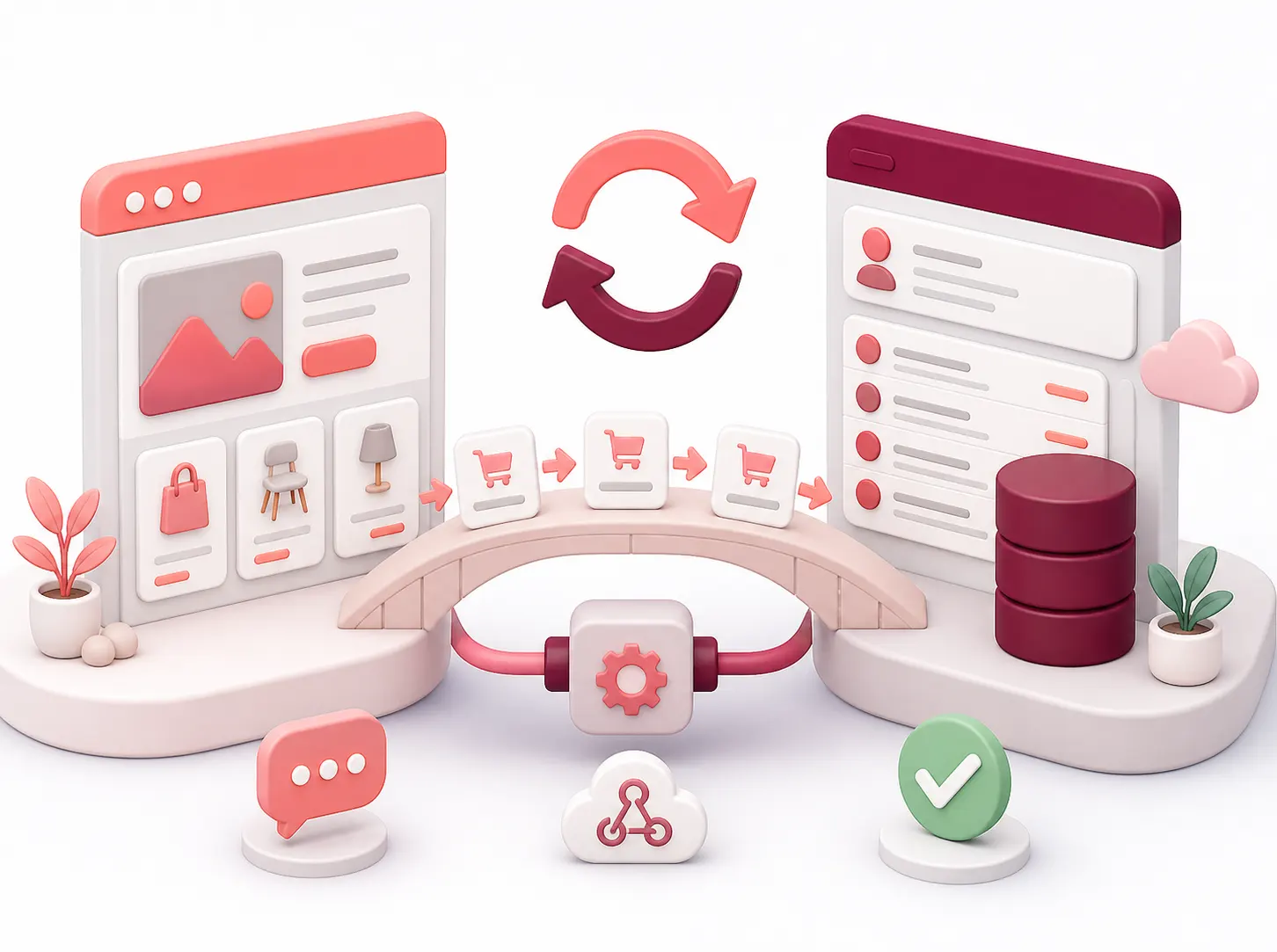
NextDoorCoders’ services include CRM implementation and integration with corporate websites, online stores, landing pages, and web services. We work with Laravel, WordPress, and OpenCart sites, whether built from scratch or on templates. If a company has several brands or branches, CRM integration can be set up for multiple business lines at once. Data is transferred via API webhooks and other modern exchange protocols, so leads, customer records, and deal statuses update automatically. As one NextDoorCoders specialist puts it: “The real difficulty isn’t the CRM or the website — it’s making sure the data moves between them without loss or delay.”The Technical Process: How We Set Up Integration Without Stopping Your Work
CRM implementation and website connection happen without stopping your sales team’s work. First, we analyze the forms on the website and configure chatbots to pass data to the CRM as a separate stream. Next, we connect an API webhook for lead delivery and set up lead-distribution rules between managers. Finally, we test everything on real leads. Main stages of technical setup:| Stage | What Happens | Timeline |
|---|---|---|
| Analysis and preparation | Audit of website forms, chatbot architecture, and identification of lead sources | 1 day |
| Integration and logic | Setting up data transfer, configuration, launching lead-distribution rules | 2–3 days |
| Testing | Verifying correctness | 1 day |
Cost and Timeline for Integration
The cost of implementing and connecting a CRM to your website depends on the number of forms, whether there’s a chatbot or callback button, and how complex the lead-distribution logic needs to be. In most cases, the work takes a few days and doesn’t require a developer on the client’s side. If the website is fairly standard, the setup goes faster; more complex cases with multiple traffic sources need extra time for testing. Payment is usually a fixed fee for the integration project, after which the team verifies the integration together with the client using real leads.Order CRM Website Integration
We connect your CRM to the website so every lead lands in the system instantly — no manual data transfer, no lost leads
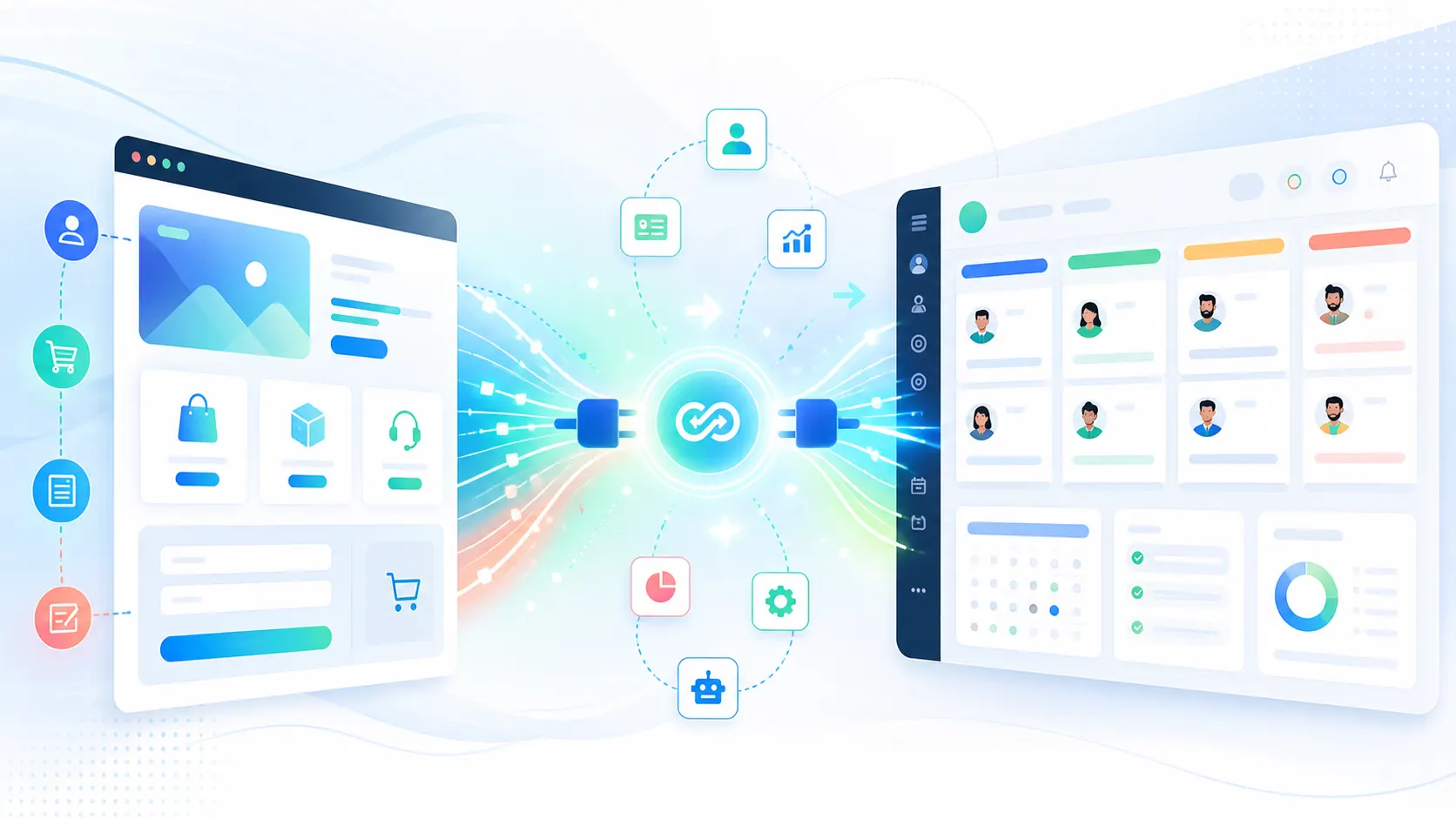
CRM Integration by NextDoorCoders — Automating Lead Handling
What's Included in a CRM Website Integration
Audit of forms and lead sources
We check all forms on your website, callback buttons, and chatbots to understand where leads come from and exactly what needs to be sent to the CRM.Connection via API webhook
We set up data transfer using modern integration protocols — contacts, customer records, and deal statuses update in the CRM automatically.Transfer of UTM tags and traffic source
Along with contact details, the CRM receives UTM tags and the exact time a lead was submitted — giving you a full picture for channel performance analysis.Client history isn't scattered across channels
If a client messaged the chatbot and also filled out a form, both interactions land in one CRM card instead of separate places.Leads don't get lost even on your busiest days
When inquiries spike — during a promo or a seasonal rush — every lead still gets logged in the CRM instead of slipping through the cracks.CRM is shared, not one manager's inbox
Leads go into the shared CRM, not a specific employee’s personal inbox. The whole team can see contact history, even if the person who usually replies is out.When It's Time to Connect a CRM to Your Website

If leads from your website are still handled manually — copied from email into spreadsheets or files — some of them get lost before the manager even makes the first call. CRM integration closes this gap and sends every lead into the system automatically, right after the form is submitted.
- →Companies receiving leads from multiple forms or traffic sources.
- →Online stores and landing pages that can't afford to lose leads.
- →Businesses with a sales team that works in a CRM every day.
- →Companies that still copy leads into spreadsheets or files by hand.
- →Websites where leads arrive not just through forms, but also via a callback button or chatbot.
- →Companies that need to see which ad channel each lead came from.
What Problems CRM Integration Solves
Leads no longer get lost in email
Leads don’t sit in the website admin’s shared inbox, where they’re easy to miss among other messages.Managers get contacts without delay
The lead reaches the CRM right after the form is submitted — customers no longer wait because of manual data transfer.No duplicate customer contacts
The system tracks repeat form submissions from the same customer, so customer records don’t get duplicated.Callback leads join the same stream
A client clicks callback, and the lead lands in the CRM right alongside leads from your other forms. No separate manual step needed.Teams work from one shared customer database
Marketing, sales, and support see the same customer information, with no discrepancies between spreadsheets and files.The owner sees response speed to each lead
The time a lead is submitted is logged automatically, making it easy to track how quickly managers respond to customers.How CRM Integration Works, Step by Step
Audit of forms and lead sources
We review your website's forms, chatbot setup, and lead sources to understand exactly what data needs to move to the CRM, and from where. Takes about 1 day.
Setting up data transfer
We configure an API webhook for the automatic transfer of contacts, UTM tags, and deal statuses into the CRM.
Checking deal fields and statuses
We agree on which fields and statuses the CRM should show, so each lead arrives with a complete data set — no manual re-entry into cards.
Checking extra channels — chatbot and callback
If the site has a chatbot or callback button, we check the format of their leads and configure them to pass the same fields as the main forms.
Testing on real leads
We verify that data transfers correctly using real leads, not sample data — this stage takes about 1 day.
Final check together with the client
We confirm the integration works reliably and walk the client through the result before calling the setup complete.
Why Choose Us
Transparent Terms of Cooperation
A contract with clear timelines and scope. No hidden fees — the integration cost is fixed upfront.Fixed Integration Cost
You pay for the CRM integration project, not developer hours — we agree on the amount before work begins.Ongoing Communication
In whichever channel works for you: Telegram, Google Meet. Your manager stays in touch throughout the setup.Progress Reporting at Every Stage
See the progress at each stage: form analysis, data-transfer setup, testing on real leads.Testing on Real Leads
Before we call the integration complete, we test it together with you on real, live leads.Audit of Forms and Lead Sources
Before connecting anything, we review your website's forms, chatbots, and traffic sources so nothing gets lost during integration. Back-End (development)


 Front-End (web implementation)





 Payment integrations













 Integration with delivery





 Analytics and pixels




 Mailing systems


 Marketplaces, Feeds, CRM, Bots, and Messaging










 Flexible integrations
Turnkey website development from NextDoorCoders — creating quality websites for your business
We have been working with NextDoorCoders since 2023, and during this time we have been convinced of the high level of service provision and professionalism of the team. During this period, we managed to work both together at the sales stage (we closed seo at the development stage, the partner – site development), and as a team on projects, marketing activities, exchange of insights/hypotheses.
Our clients are grateful for the individual approach to each project, which makes cooperation even more effective. After all, the ability to choose a solution and technology and calculate various implementation options makes NDC quite flexible.
Thank you to Volodymyr and his team for quality, responsibility and joint movement towards the result! 🚀
We would like to separately note the ability to find solutions even in complex tasks – this is what truly distinguishes NextDoorCoders from others. The team does not just complete the task, but offers optimal options to achieve the best result. We were convinced of this on joint projects.
Openness to multifaceted partnerships has also allowed us to be active in marketing: implementing joint cases, being active in the infospace, and writing joint publications on social networks.
Such comprehensive cooperation allows us to be more competitive.



We have been working with NDC since the beginning of 2021. We had a task to find developers who would improve the functionality and support our project and several self-hosted websites. It took us a while to find specialists, as we were getting rejected because we were using an outdated framework. However, NDC stepped in to help, and we quickly agreed to cooperate.
At first, we successfully implemented the accumulated pool of tasks, and later we made a number of large-scale improvements together. Of course, as in any workflow, there were some issues that needed to be agreed upon, including task and time tracking and estimating the scope of work. However, thanks to our openness to dialogue and mutual interest, we managed to establish effective cooperation.
Now the volume of tasks for revision is not very large, but all support issues are resolved promptly and professionally. I consider our cooperation to be fruitful. I can safely recommend NDC as web developers. I wish them adequate customers and interesting large projects.

Our company, All-Ukrainian Management Systems, specialises in implementing and configuring business management systems. We help companies automate processes, increase efficiency and scale their operations.
One of the most frequent requests from our clients is the creation of B2B portals that allow them to optimise interaction with partners and customers, automate orders, improve process control, and reduce costs.
In such projects, we rely on our reliable partners, NextDoorCoders (NDC). This team has deep technical knowledge and practical experience in implementing B2B platforms. NextDoorCoders: professionals in their field, responsible, result-oriented, always offering the best technological solutions and effective teamwork.
Cooperation with NextDoorCoders is a guarantee of successful implementation of B2B projects. We confidently recommend them as a partner who does not just perform tasks, but creates effective business tools that bring real results.


About 6 months ago, we needed to finalise our new rentsoft.ua website, which was handed over to us in an unfinished form by our previous contractors. We decided to find a replacement for them, as the speed of task completion and communication were important to us. On recommendation, we were offered to work with NDC. The recommendation met our expectations.
The young team is very flexible in their approach to our requirements and changes in the priority of tasks. The guys are always ready to meet us halfway and, if necessary, prioritise an important task for us.
Constant daily communication and quick turnaround time have always given us a sense of confidence that the project is being handled and that the contractor values its customers.

I’ve been looking for smart and reliable specialists to improve my website for a long time, and I was finally lucky. The challenge was that the website was not developed by professionals and had numerous issues in its code, which made everyone unwilling to review it.
I communicate with Vladimir, and the tasks are solved as quickly and efficiently as possible.
It’s a pleasure to work with such people. Thank you very much!

We have been successfully working with NextDoorCoders since August 2024. During this time, they have provided fast and high-quality support, significantly improving our website’s performance and user experience through professional recommendations and ongoing technical support.



We have been cooperating with the NextDoorCoders web studio since the beginning of 2024. During this time, the studio has established itself as a reliable technical partner who is attentive to the client’s needs. The team regularly provides professional recommendations on improving the site, performs work on SEO-technical tasks and qualitatively refines the functionality.
All tasks are performed on time, with a responsible approach and good communication. In general, we are satisfied with the cooperation and can recommend NextDoorCoders as a competent and convenient contractor.


We have a pleasant experience of cooperation with the NextDoorCoders web studio, which has been helping us with the finalization of the site’s functionality since the end of 2024. The team is always in touch, responds quickly to requests and pays attention to all details. All tasks are performed qualitatively and within the agreed deadlines. We especially appreciate the ability to delve into the specifics of the business and offer appropriate solutions. Communication is easy, open and constructive. We sincerely recommend NextDoorCoders as a reliable partner in the field of web development.

We have been working with NextDoorCoders since 2021.
We ordered the development of a CRM for production process management from them.
The team understands business needs perfectly: they implemented a convenient system for accounting for orders, controlling production, and automating many routine processes. We are constantly improving the functionality together with them.
We recommend them as a technical partner who understands the specifics of production and business processes.

We collaborated with the NextDoorCoders team on the creation of our website and were very satisfied. The work was done quickly, clearly and qualitatively. All our wishes were taken into account, and corrections were made without unnecessary delays.
The team was always in touch, suggesting solutions and helping when we did not understand something. It is very pleasant to work with people who are not only knowledgeable in technical matters, but are also truly interested in the result. Communication was easy and comfortable.
The website works stably, looks modern, and we are already receiving positive feedback from clients. There were no difficulties during the cooperation.
Thank you to the team for their approach and professionalism! We will be happy to contact them again if we have the opportunity.


On behalf of our company, we would like to express our gratitude to the NextDoorCoders team for their cooperation in the implementation of several projects, including the European startup Cooontacts. This product is designed to solve the language barrier problem in Europe – to give businesses the opportunity to find customers in their native language and, conversely, to help people quickly find those who speak their language. The task was not easy, the development environment was quite complex, but all the necessary functions were implemented within the agreed deadlines.
We especially appreciate the team’s readiness for operational improvements: despite the fact that technical and business requirements changed during the work, the guys never refused to make changes and thoroughly understood each task. In addition to the purely software part, they deeply immersed themselves in our idea, offered their own concepts and solution options, which helped to improve the product and avoid many common mistakes.
As a result, we got not just contractors, but reliable partners with whom it is pleasant to work. Thank you NextDoorCoders for your professional approach, flexibility, and responsibility — we look forward to new joint projects.

NextDoorCoders has been providing technical support for our website for a long time. Working with them is convenient: they are always available, respond quickly to requests, and do everything accurately and without unnecessary reminders. We have been working together since 2021, and during this time, we have had no complaints. The team is responsible, attentive to detail, and simply pleasant to communicate with. We recommend them!

We have been working with the NextDoorCoders team for a long time. They were implemented for our website redesign, and now they are engaged in support and implementation of new tasks. Communication is always on the level, they respond quickly, everything is discussed simply.
I like that the team does not just perform the task, but also suggests how to do it more conveniently or efficiently.
Working with them is easy and pleasant. We are happy to have found such a wonderful and responsible team.

We have experience working with the NextDoorCoders team since 2019. We have always been satisfied with the results. They migrated the site and helped with smaller tasks, making the resource look modern and convenient to use. The team always listens carefully to our wishes and offers solutions that really work.
We especially appreciate the speed of response and open communication – this creates a feeling of reliable partnership. Over the years, we have been convinced of our professionalism and appropriate approach to the matter. This is cooperation that can be recommended to others.

We turned to NextDoorCoders to create a website for our nail service courses. They did everything efficiently and on time, and also offered their own ideas that helped improve the result. Cooperation was easy and pleasant – the team was always in touch and communicated openly.
We liked that they cared not only about the completion of the tasks, but also about the overall quality of the project. As a result, we received a modern and convenient website that we were satisfied with. We can recommend NextDoorCoders as reliable partners for any web projects.


NextDoorCoders created a modern, intuitive and functional website for us, which fully meets our business requirements.
All stages of work — from concept development to successful launch into production — were carried out with a high level of professionalism.
We would like to separately note our effective approach to communication, attention to the smallest details and ability to promptly resolve any issues.
After launch, the site remains supported by a team that ensures its stable operation and further development. We confidently recommend NextDoorCoders as a reliable technological partner for the creation and support of web projects.

We, Piranil Company, started cooperation with NDC in September 2025 and have been successfully working on the tasks since then.
The team has proven itself as a reliable partner who does not just fulfill requests, but really immerses itself in business processes.
We especially appreciate that they always offer several solution options and help to choose the optimal one.
Communication is fast, clear and without unnecessary bureaucracy, which greatly simplifies the workflow. There is a sense of responsibility for the result and a desire to do more than just “according to the specifications”. We are satisfied with the cooperation.

NDC developed a corporate website for us for logistics services, and we are completely satisfied with the result of cooperation.
The team professionally performed the layout, taking into account all our wishes.
Since the start of work in 2023 and after the launch – the site has been working stably, and technical support always responds quickly to our requests.
You can feel the responsibility, deep immersion in the project and a real desire to help achieve the best result.
We definitely recommend NextDoorCoders as a reliable partner for the development and support of web projects.

Our collaboration began when the team built our website from scratch in 2019, and they’ve been maintaining it ever since. Not only are they experts in their field, but they also genuinely care about the success of our store. Working with them is easy and a pleasure!


Working with the NextDoorCoders team was a smooth and pleasant experience. They assisted us with development on the OpenCart platform, were actively involved in the project, and were always available to communicate. We appreciated their responsible approach, clear communication, and attention to detail. All issues were resolved quickly and without any unnecessary complications. Thank you for your collaboration, and we wish them continued success and exciting projects!